What tea farms taught GPP alumna and Stronach Prize winner Shreya Chaudhuri about climate justice

Shreya Chaudhuri — an alumna of UC Berkeley’s Global Poverty and Practice (GPP) minor — was raised in the Bay Area, but she spent her summers thousands of miles away in eastern India, on her family’s tea farms in Assam.

She comes from a long line of tea farmers who cultivated the land long before global supply chains and corporate monopolies reshaped the region’s tea industry. Though she didn’t grow up on the farms full time, that history shaped how she understood land and labor.

Her mother carried that connection closer to home, spending time with Chaudhuri outdoors along the Bay Area’s beaches and among the redwood forests. Chaudhuri often tagged along while her mother gardened.

“I would mostly be talking,” Chaudhuri said, laughing. “But I was still with her outside.”

From those early experiences, Chaudhuri absorbed a philosophy that would shape her worldview and pull her towards environmental justice.

“Live in reciprocity with the land, respect the earth, and respect nature,” Chaudhuri said. “Never take more than you give.”

In middle school, Chaudhuri’s science teacher encouraged students to design their science fair projects around real-world problems, which stuck with her as she discovered her own interest in environmental science.

She found her footing during her senior year of high school, where her project on lead pollution in sub-Saharan Africa explored how algae could be used as a nature-based solution to remove heavy metals from water.

The project earned international recognition and was published with UNESCO, but more importantly, she said, it reframed her relationship to science — seeing it as a means of addressing inequality and environmental harm.

Her love for the environment would ultimately define her time at UC Berkeley, where she graduated in Spring 2025, received the Stronach Prize, and returned soon after to serve as a visiting scholar. Over the course of her education, Chaudhuri combined technical training in the sciences with political analysis, double majoring in environmental science and geography with an additional minor in data science.

The GPP minor program, however, is what Chaudhuri said truly “laid the foundation” for work with local communities in India.

The Global Poverty and Practice minor program, offered through the Blum Center of Developing Economies, challenges students to examine the structural roots of poverty and inequality while applying academic learning to community-engaged work.

Upon arriving at UC Berkeley, Chaudhuri planned to pursue a technical career in environmental microbiology. But after spending a summer working full time in a lab at the Carnegie Institution for Science her freshman year, she realized something was missing.

“There were already so many climate solutions,” she said. “But there wasn’t a bridge between the people who needed them the most and the people who were building them.”

Chaudhuri said that after taking several courses in the GPP minor, she was convinced the program could offer her something that no others at Berkeley could: coverage of perspectives from the Global South on climate change.

That focus shaped how Chaudhuri approached her GPP practice experience. Encouraged by GPP faculty to work with communities they were already part of, Chaudhuri centered the project on her own community in Assam. A defining element of the program, the practice experience is designed to help students bridge theoretical frameworks with real-world poverty action.

She got the inspiration from a trip to India over two years ago, when she returned to her uncle’s tea farm and saw firsthand how farmers were reviving Indigenous agricultural practices — such as polyculture, mulching, and composting — in response to climate change and corporatization.

“It was incredible to see the on-the-ground work that’s happening in frontline communities,” Chaudhuri said. “I wanted to be able to go back into my community and help co-create something meaningful together.”

After learning more about her own family’s historic struggle with colonial rule over their farmland, Chaudhuri decided to document these Indigenous ecological methods while also examining colonial tea plantations in Assam and how colonialism has shaped the community’s ecology and geography.

That research expanded into her senior theses and, later, became the basis for the follow-up initiative — Equi-Tea: মাটিৰ মুক্তি, মানুহৰ মুক্তি (“liberation of the land is liberation of her people”) — that earned her the prestigious Judith Lee Stronach Baccalaureate Prize.

Through the prize, Chaudhuri is working with farmers today in Assam to build a direct-to-consumer tea brand rooted in those same Indigenous ecological principles. The model prioritizes organic cultivation and farmer-led decision-making, while cutting out corporate intermediaries that often absorb the bulk of profits. Even well-meaning brands limit farmer autonomy, she said, and don’t use the surplus profits to reinvest in the agrarian communities, who are struggling to transition to agroforestry. Chaudhuri’s brand aims to emphasize local economies, ecologies, and autonomies, while building bridges between the producers and consumers — something that the colonial supply chain sought to eradicate.

To tell their story, Chaudhuri is producing a short 30-minute film, drawing on interviews with farmers and footage from the fields. The goal, she said, is to show American audiences how tea farmers are struggling with climate change, colonial legacies, and global markets.

“They’re focused on daily survival and making sure that their tea farms last and exist; they don’t have the capacity to build out the storytelling and marketing models that a lot of brands in America do,” Chaudhuri said. “I want people to know what tea farms are going through because it is a microcosm of the climate crisis.”

She also brought this work back to UC Berkeley last summer through an interactive tea exhibition at the South and Southeast Asian Library in partnership with the Institute of South Asia Studies. While she worked as a Climate Action Fellow at the Student Environmental Resource Center, she created a campus café pop-up, where visitors could sample tea grown ethically using Indigenous methods.

Alongside her work on tea, Chaudhuri emphasized the importance of climate education, something she’s been actively pursuing since she was 16 when she founded Project Planet, a nonprofit dedicated to decolonial environmental education. On campus, this took shape as the Decolonizing Environmentalism DeCal she founded, as well as the Decolonial Environmental Network and American Cultures Environmental Justice Initiative.

Across all her experience, however, Chaudhuri stresses the importance of paying attention to how climate change is experienced on the frontlines, as well as to the Indigenous science, often overlooked in mainstream climate research, that communities already use to adapt to changing conditions.

“The majority of the people in this world are at the margins of the climate conversation, and we have to center their stories,” Chaudhuri said. “We have to center their narratives.”

How Michelle Gallaga found community and belonging through the Global Poverty & Practice minor

When Michelle Gallaga moved to the U.S. from the Philippines with her two young kids in 2010, she didn’t know anyone in her new home.

“We had to start a life and really try to navigate being an immigrant and all the hardships that come with it,” she says.

“When you move to a different country at 40,” she adds, “people already have their own friends and their cliques, and so I never really got to form my own group of friends.”

Not having completed college, she found, limited her opportunities, and she encouraged her kids to pursue the degree she hadn’t attained. Once they had left home to do so, however, it didn’t sit quite right with her that she had pushed them to do something that she herself hadn’t been able to.

And so, as a birthday present to herself, Gallaga enrolled at Berkeley City College, and not without some apprehension.

But it wasn’t the first time that the graduating Global Poverty & Practice student had enrolled in college.

Gallaga had attended the University of the Philippines Conservatory of Music in Diliman as a voice major, while belonging to the Philippine Madrigal Singers, an a capella choir that took her around the world for festivals, world tours, and competitions.

She spent seven months away from the Philippines during the group’s 1989 tour and found it difficult to re-enroll in classes after returning, choosing to stay on with the choir for another three years.

She eventually did go back to school again, this time for music theory, but dropped out after joining a cover band.

In 2000, Gallaga got married, retired from singing, and gave college another shot, studying education to become an elementary school teacher. For two years she taught English in rural schools with poor infrastructure and limited educational resources.

“I loved the experience of being there and being around the enthusiasm of the children,” she said. “It was so fulfilling and so humbling. There was something about giving yourself to it that you get so much out of.”

But a divorce brought an end to the calling she had begun to develop, and she had to drop out again. Eventually, she moved to the U.S.

Now, years later in Berkeley, Gallaga was quickly discovering that she loved being back in the classroom.

With so much more life experience to apply to her lessons, the curriculum clicked in a way it hadn’t before. In 2023, she transferred to UC Berkeley to study sociology.

But making the most of her time at the country’s top public university was difficult while working two jobs: one providing translation and interpreting services for San Francisco government agencies, and another assisting a social entrepreneur pushing for equity in the psychedelics space. She could only attend class two days a week — not enough to build relationships or finally find community.

That is, until she met Valerie Moss, the Blum Center’s Assistant Director of Student Affairs, at a Global Poverty & Practice minor tabling session on campus. Examining and addressing poverty immediately struck a chord with Gallaga and harkened back to her experience teaching students in underserved schools.

Her first class, GPP 115: Global Poverty: Challenges and Hopes, “blew my mind,” she said.

Its lessons about understanding 20th-century development and 21st-century poverty alleviation left her feeling like “I was living a lie all my life,” she laughed.

This is it, she thought during that first semester in the minor. I want to learn more.

Her biggest lesson, she said, has come this current semester. She had arrived at GPP believing that the only way to make a difference in poverty alleviation was to do work that produced obvious, immediate results.

But “you may not see those results right away,” Prof. Khalid Kadir counseled in her Global Poverty & Practice Capstone Course. The impacts may not appear for generations, he said, but the important thing is that you took action.

The minor’s appeal, however, went beyond its curriculum.

“GPP is like family to me,” Gallaga said. “It was my only way to meet more students and build relationships.”

Her standing in the program led Prof. Clare Talwalker to recommend her as an advisor to her peers in the minor, to which she enthusiastically agreed.

“Joining the minor was the smartest thing to do,” Gallaga said, “because GPP gave me the community that I needed to really feel like I belonged at UC Berkeley.”

For her practice experience, a core component of the program where students apply what they learn, Gallaga volunteered with Spiral Gardens, a small, nonprofit community garden providing fresh, nutritious produce in a historically redlined Berkeley neighborhood and food desert — a place she herself had lived in for 10 years.

Michelle Gallaga, at Spiral Gardens, holding produce grown at the community farm. (courtesy photo)
Gallaga at Spiral Gardens (courtesy photo)

Each Sunday, she would give tours of the garden to new volunteers, helped them get their own small garden projects off the ground, and mentored them. She grew food for her geographic community and gained the social community she had spent years looking for in the Bay Area and had begun to find in GPP.

Volunteering with Spiral Gardens also put into practice the lesson Prof. Kadir had imparted. Her biggest takeaway from GPP, Gallaga said, was “that I was there. I was a part of something. I did what I could, and I’ll keep doing what I can. And that’s enough. That’s what matters.”

After graduating this month, she plans to stay in the poverty-alleviation and nonprofit space. “Being able to keep working with organizations that help other people will always make me feel like I belong,” she said.

Her son graduated from UC Irvine in June, and her daughter will graduate from UC Santa Cruz next June.

“When I told my son, ‘I got into UC Berkeley!’ he was so jealous because he got rejected from Berkeley,” she recalled with a laugh. “But when I told him I got in, he said, ‘Mom’s the GOAT!’” — the greatest of all time.

And come December 20, when Gallaga crosses the stage to receive her diploma, they’ll be there to celebrate her degree.

How Dr. Evan Mills, with Blum Center support, helped put off-grid solar on the map

With support from the Blum Center, the Berkeley Lab scientist and his colleagues provided the first substantive analysis of how electric lighting — specifically, high-efficiency solar-powered electric light sources unattached to an electrical grid — improves the lives and well-being of people using fuel-based lighting.

After attending a conference on electric lighting efficiency in New Delhi, India in 1995, Dr. Evan Mills stopped by Varanasi for a vacation. 

One night, he wandered through a car-free warren of alleys lined with shopkeepers. Standing against a wall in the marketplace watching humanity flow by, he had an epiphany — one that 

A merchant in Varanasi, India using a kerosene lantern during a night market. (Photo by Evan Mills)

would help pave the way for the adoption of off-grid solar lighting on a wide scale.

“I look down to my left, and there’s a man with a blanket spread out, three feet by three feet. He’s selling bracelets and beads, and he’s got a kerosene lamp that’s lighting his wares, and everything’s sparkling,” Mills, then a scientist at Lawrence Berkeley National Laboratory, recalled. “And that was the proverbial ah-ha moment.”

At first glance, such lamps have an enchanting aura to them. But after that conference, Mills couldn’t help but wonder how much fuel the vendor was using, how much carbon dioxide was being released, how many others out there relied on this dim source of light to practice their business, and whether viable alternatives could be developed and brought to market.

“And then I started this odyssey,” he said, “that went on for decades to really try to nail that down.”

With support from the Blum Center and several other funders, Mills and his colleagues addressed a gaping hole in lighting research. They provided the first substantive analysis of how electric lighting — specifically, high-efficiency solar-powered electric light sources unattached to an electrical grid — improves the lives and wellbeing of people using fuel-based lighting. He calls it “wireless lighting.” They went on to create and implement international standards for such products.

Dr. Evan Mills with kerosene lamps and early solar lanterns collected for testing (courtesy photo)

GOGLA, an international organization that later picked up the mantle of this work, has reached about 140 million people in the developing world by supporting dozens of companies and investors. Non-profit groups such as Light Up the World also did pioneering work on this problem.

Fuel-based lighting, on the other hand, like the Varanasi merchant’s kerosene lamp, is associated with various health, environmental, and economic problems.

Beyond the difficulty in doing basic activities under such dim and inefficient light sources, they are fire and burn hazards and can wreck indoor air quality. They are orders of magnitude more expensive than fluorescent or even “inefficient” incandescent lighting, per lumen (a unit of brightness).

“A homeowner [in the U.S.] spends maybe five percent of their income on energy,” including for their car, house, heating, cooling, refrigeration and more, Mills explained. “A very poor person can spend five percent of their income on kerosene lighting alone.” 

Under the Lumina Project, Mills organized his studies of off-grid lighting solutions for low-income communities around the world, as well as the provision of information and analysis to consumers, industry, and policymakers.

Mills’ mentor, Arthur Rosenfeld, won the Department of Energy’s 2005 Enrico Fermi Presidential Award and a $375,000 honorarium.

“He just gifted it to the Blum Center and said, ‘Here, do something good with it,’” Mills said.

That good funded the Lumina Project and other activities at the Blum Center.

“We were very lean and mean,” Mills said, applying the Center’s funding to equipment purchases, travel to countries for research, and supporting Berkeley students getting involved in the project. “We made the resources go really far.”

A huge area of research Mills and his team were able to pursue was market characterization and needs assessments. On the technology side, white LED lights had just been commercialized, which meant that by packaging small rechargeable lithium or nickel-cadmium batteries and tiny solar panels, one could create portable and affordable solar lanterns at a fraction of the cost of bulky incumbent systems. Miniaturization and pre-purchase assembly of components stood to be major breakthroughs.

Users of fuel-based lighting are “not a monolith,” Mills said. “It’s not just a kid with a lantern doing their homework.” It’s also a doctor treating patients in a clinic, a schoolteacher in a windowless classroom trying to light their chalkboard, fisherpeople on a lake at night, chicken growers, nighttime security guards, people in cottage industries, and women moving around refugee camps. How did all these people use light? What did they pay for it? What were their nuts-and-bolts engineering needs? 

A night market in Kisumu, Kenya (Photo by Evan Mills)

From Kenya to India, Tanzania to Bhutan, Mills and his Berkeley students would take prototypes of portable electric lighting sources — which don’t require special expertise to set up — into communities and be peppered with questions by prospective users already well versed in issues around lumens and durability. 

When a community’s health clinics adopted off-grid solar lighting, postnatal maternal mortality decreased, as did infection rates. At kerosene-lit night markets, the diverse colors of goods like flip-flop sandals would wash out into the same hue; under LED headlamps, the colors became immediately distinguishable — along with enough light for vendors to count change under the table. Unlike candles and lanterns, solar lanterns would keep working in the wind and rain, and users weren’t vulnerable to fuel shortages or price spikes.

The funding from the Blum Center also allowed students to spend weeks in Kenya and Tanzania to join night fishing trips on Lake Victoria.

Some 100,000 people go out onto its waters each night, Mills said, with kerosene lanterns floating on little rafts to attract the fish’s food sources, which allows fishers to draw the fish into their nets. But half their income from one night’s catch would go toward kerosene for the next night’s trip, keeping the people impoverished.

Mills and his team built prototypes of LED lamps, and the students spent night after night weighing fish caught with the kerosene and electric lamps and comparing the costs associated with both kinds of catches. The electric lamps essentially doubled their income. They got the same results on Lake Tanganyika and at sea.

Fishers on Lake Victoria using an LED lamp developed by LBNL and UC Berkeley students (Photo by Tim Gengnagel)

They also dug deeper into the health effects of fuel-based lighting: not just the worse indoor air quality and the deadly fires that kerosene lanterns can cause, but synthesizing the literature from doctors treating young children who had been burned by these lamps or had accidentally consumed kerosene. They learned that people who suffered medical emergencies at night often had to wait until daylight to be seen at a clinic, exacerbating their illness or injury and causing longer clinic lines for everyone.

Mills also shed new light on the scale and effects of kerosene subsidies ($35 billion annually), the potential for job creation with electric lighting, and the resources the latter required. They estimated that 150,000 jobs in the world involved kerosene lighting, but the widespread adoption of off-grid solar lighting could potentially produce two million jobs. They also figured out the energy and resources it took to make their LED lanterns and how long those lanterns would have to be used to make up for what was put in. (Twenty to fifty days for a device that would last years.)

There was, however, one snake in the garden. More and more companies were producing affordable, turnkey off-grid solar lighting devices. Mills’ team tested many of them and found considerable variability in the quality of their light output, batteries, wiring, and more. 

“Eventually the World Bank got a whiff of this,” Mills said — specifically its International Finance Corporation. Mills helped them develop a successful proposal to the Global Environmental Facility (GEF) to scale up a market-transformation effort.

Mills brought aboard Arne Jacobson of Cal Poly Humboldt’s Schatz Energy Research Center, who, while a PhD student in Cal’s Energy and Resources Group, had studied why older solar lighting systems — featuring big panels, long fluorescent tubes, and heavy car batteries that required an electrician and a year of income to buy — hadn’t been widely adopted. Virtually every obstacle could be overcome with the emerging compact LED systems.

Building on that work, the Berkeley Lab–Humboldt collaboration helped IFC develop test procedures and create a quality-assurance program. At the core was a product-certification program (today called VeraSol). Companies took to it quickly, Mills said, learning how to improve their products. And a warranty and truth-in-advertising component was essential to prevent market spoiling: users having a bad experience with a deficient product and giving up altogether on off-grid electrical lighting.

The momentum for off-grid lighting kept building. A regular conference, organized by IFC, attracted people from dozens of countries, including environmentalists, government officials, and investors. A vibrant, online social network was set up where folks around the world shared insights and innovations, troubleshooted issues together, and found community. As a sign of the gradual mainstreaming, television soap operas in Africa depicted people purchasing solar lanterns.

Eventually the United Nations took note.

The UN Environment Programme wanted to know the carbon-offset value of using a solar lantern, and commissioned Mills and his colleagues to develop a methodology the UNEP could use to evaluate the use of solar lanterns in carbon markets. Their methodology’s adoption came at a critical time given what had been learned about the variability in product performance and quality.

Despite all the success, Mills said, the World Bank and IFC did not intend to stick with off-grid lighting indefinitely, and the movement needed a new organization to continue carrying the torch. 

Its proponents founded the Global Off-Grid Lighting Association, which shortened its name to GOGLA once it expanded to include compact and portable solar home kits that made solar energy services more affordable and useful beyond just lighting. GOGLA now assists the off-grid solar community with finance, consumer protection and standards, market insights, advocacy, policy, and more. 

Mills, now retired from Berkeley Lab, has moved on to work on other problems. When he started this work, over a billion people lacked electricity. Some 140 million people across the developing world now benefit from the improved products, with about 7 million solar lanterns and multi-light kits and 1.6 million full solar home systems sold each year. 

Berkeley students were essential to collecting the data that became the backbone of what the off-grid industry has become, Mills said. As was the Blum Center’s flexibility.

“Complex undertakings like this do take time, and they take patience and dedicated sponsors,” he said. “The Blum Center generously provided us with a lot of trust and latitude to be nimble and respond to new ideas and opportunities.”

“It was so exciting because it was such a green-field area,” Mills added. “There were other people who were poking at this, for sure. But we were right there at the beginning, and the Blum Center was right there on the ground floor with us.”

GPP’s Class of 2025 Driven by Compassion, Connection, and Humanity

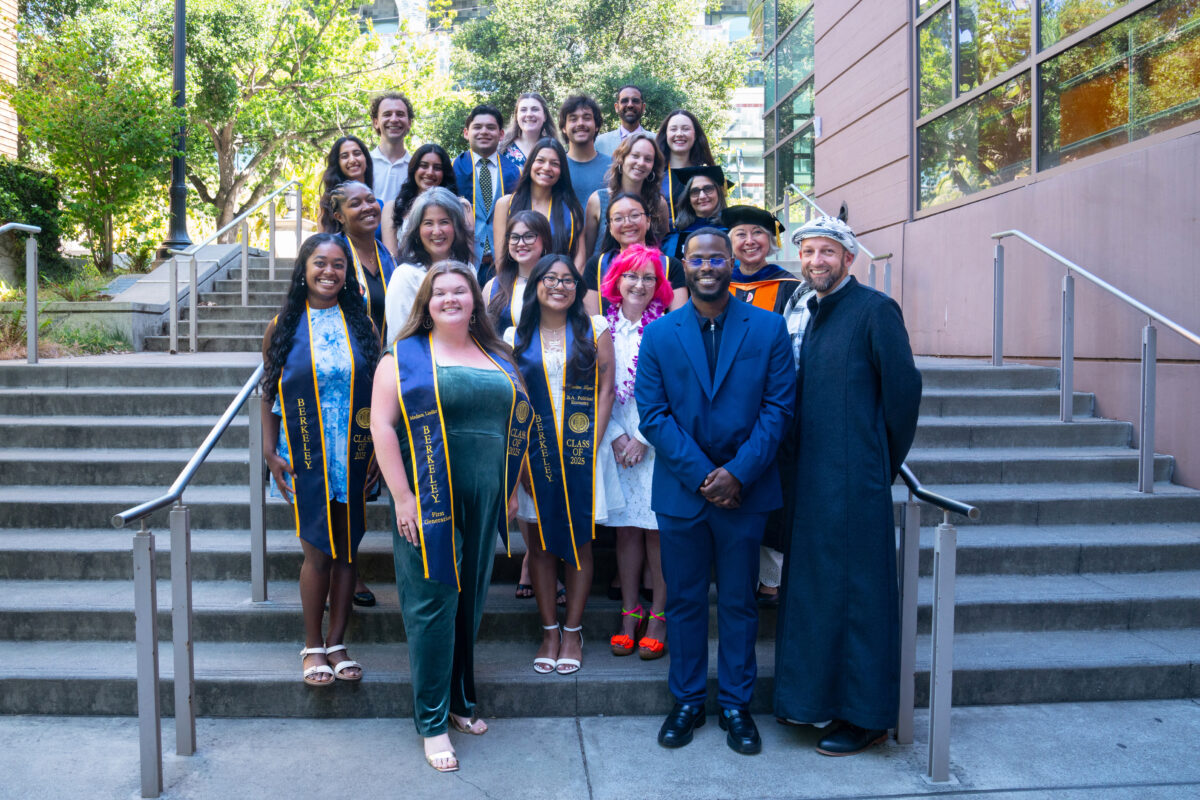
As this year’s Global Poverty and Practice (GPP) graduates stepped onto the stage to receive their diplomas, they carried with them a hard-earned insight: the injustices they spent years studying weren’t distant or theoretical — they were urgent and unfolding all around them. Their time in the program has prepared them to enter the world beyond Berkeley with a strong sense of purpose, ready to confront poverty in a time of growing global uncertainty.

As this year’s Global Poverty and Practice (GPP) graduates stepped onto the stage to receive their diplomas, they carried with them a hard-earned insight: the injustices they spent years studying weren’t distant or theoretical — they were urgent and unfolding all around them. Their time in the program has prepared them to enter the world beyond Berkeley with a strong sense of purpose, ready to confront poverty in a time of growing global uncertainty.

Earlier this month, friends and family filled Sutardja Dai Hall’s Banatao Auditorium to celebrate the commencement of the GPP minor’s Class of 2025, the 18th cohort of students to tackle poverty by studying the global systems and power structures that sustain inequality. 

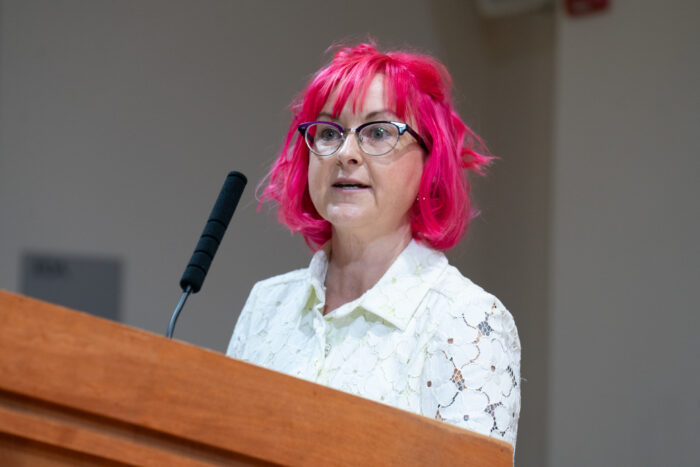
Director of the Global Studies Program and Chair of the GPP minor Elora Shehabuddin spoke to the significance of this historical moment, with graduates completing their coursework, she said, amid escalating climate disasters, emerging armed conflicts, and the first livestreamed genocide, carried out by the Israeli state against the Palestinian people.

“In every case, you learned to read and think beyond the headlines of mainstream media, to consider the histories of these conflicts and the power dynamics that shaped them, and to center the history of the human beings affected,” Shehabuddin said. “These graduates inspire all of us as champions for social justice, and they represent the best of UC Berkeley.”  

This year’s graduating class includes over 30 students representing more than 20 majors. As part of the minor, students completed a personalized practice experience that involved interning or volunteering with a government agency, nonprofit organization, or community group working on poverty issues.

A defining element of the program, the practice experience is designed to help students bridge theoretical frameworks with real-world poverty action, and it held particular meaning for student commencement speaker and legal studies major Johnna Spikes.

Johnna Spikes (Photo by Amy Sullivan)

With a family history rooted in public service, Spikes spent much of her early life engaged in similar work. She pursued a career in law, working as a paralegal and office manager at the law firm of Haddad and Sherwin. At Berkeley, she deepened her commitment to justice through internships with Legal Services for Prisoners with Children and the Ella Baker Center for Human Rights.

She joined GPP to continue her work in public service, but what she learned reshaped how she approaches that work. 

“I entered this minor with an idealistic desire to serve, as I believed that by helping those who are suffering, I’d be fulfilling some noble mission,” Spikes said. “I’ve come to realize that service without connection can become charity. True compassion doesn’t come from a place of distance, it comes from standing shoulder to shoulder, seeing the humanity in each other, and walking forward together.”

She volunteered with Old Skool Cafe, a San Francisco restaurant run by formerly incarcerated, foster care, and at-risk youth. More than just a place to eat, the cafe operates as a violence prevention program, offering job training and meaningful employment.

At Old Skool, she saw firsthand how young people often pushed to the margins weren’t treated as problems to be fixed, but as leaders — shaping the menu, helping run the restaurant, and building the kind of community they wanted to see.

“That’s what love looks like when it is rooted in justice,” Spikes said. “In this work, compassion isn’t a gesture of service, it’s a radical act of kinship grounded in the belief that there is no us and them, only us. The fight against poverty and injustice isn’t just something we choose to do, it’s something we’re here for.”

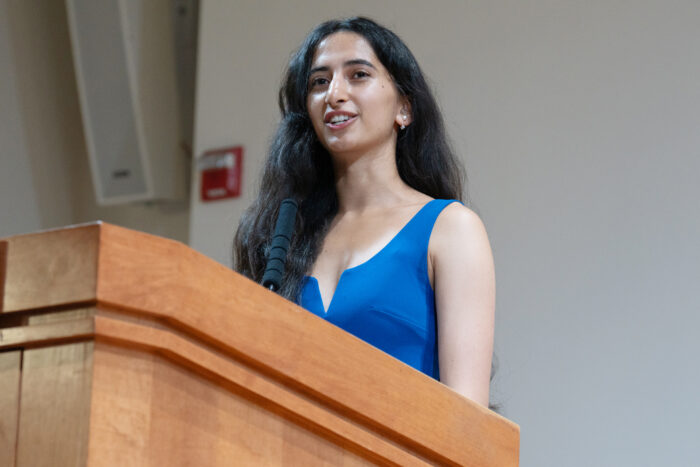
Similarly, the minor challenged student speaker and civil engineering major Anahita Banerjee to dig deeper in her search for solutions to global inequality. She has extensive experience in global water access, and her fieldwork spans rural India, Peru, and California, where she’s partnered with local communities to develop clean, dependable water infrastructure.

Anahita Banerjee (Photo by Amy Sullivan)

As a GPP minor, she said her daily assignments challenged her to confront global issues by asking tough questions like, “Why is there a housing crisis in the Bay Area? Why does the U.S. have the highest incarceration rate in the world?” 

She added that simple answers—blaming things like lack of wealth, infrastructure, or education—wouldn’t cut it. Instead, the program pushed students to keep digging until they uncovered the deeper systems behind these problems: a prison system profiting from forced labor, or policies that force formerly colonized countries to prioritize debt payments over vital infrastructure.

“Yet, I would still call these B+ answers at best, because our homework is incomplete if it remains passive,” Banerjee said. “The most important question that this minor instills in us is, ‘What are we going to do about it?’”

Driven by that same sense of responsibility, she plans to work as a reporter for a nonprofit covering water issues, and then pursue a master’s degree at the University of Oxford in Water Science, Policy, and Management. 

Facing her classmates, she expressed confidence that they will all continue to ask these critical questions and strive to “earn that A+.”

“Some of us may continue working with nonprofits, while others will work as doctors, teachers, or social workers,” Banerjee said. “However, all of us will go on to be outstanding members of society and not allow ourselves to turn away from the injustices around us.”

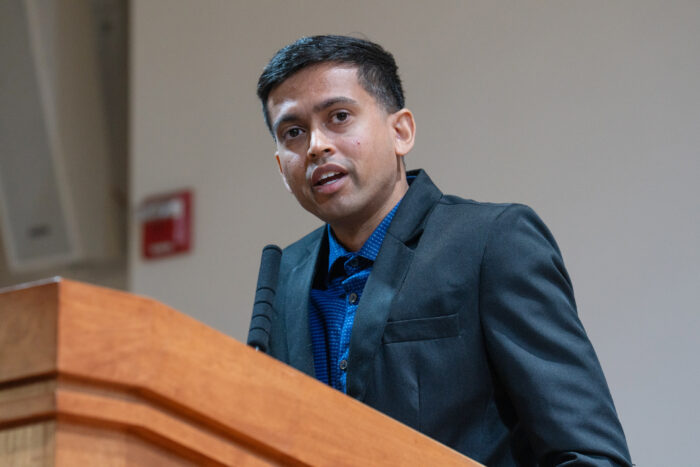
The ceremony concluded with a speech from GPP alumnus Jamal Khan. He graduated as part of the second cohort of GPP students in 2009, and went on to attend Harvard Law School. Since then, he has held positions in both the federal government and politics, including the Obama White House and Kamala Harris’s Senate campaign. He currently serves as an attorney for The Homeless Action Center

Jamal Khan (Photo by Amy Sullivan)

Drawing from his experiences in legal advocacy and direct support for unhoused individuals, incarcerated people, and those facing mental health challenges, he emphasized that dehumanization—whether in the language of war or in the bureaucracies of everyday life—is often the precursor to violence and neglect.

Khan left graduates with a powerful closing message:

“No matter the vantage point from your organization or your role, if you find yourself feeling uncertain or confused, the most important thing you can do with regard to those you’re trying to help, is to remember humanity,” Khan said. “Conågratulations, I wish you all the best. Go out there and do big things, go-getters.”

Host and Fellow Responsibilities

Host Organizations

  • Identify staff supervisor to manage I&E Climate Action Fellow
  • Submit fellowship description and tasks
  • Engage in the matching process
  • Mentor and advise students
  • Communicate with Berkeley program director and give feedback on the program.

Berkeley Program Director​

  • Communicate with host organizations, students, and other university departments to ensure smooth program operations

Student Fellows

  • Complete application and cohort activities
  • Communicate with staff and host organizations
  • Successfully complete assignments from host organization during summer practicum
  • Summarize and report summer experience activities post-fellowship